What is CI/lock?
CI/lock is a pipeline observer for CI/CD. It wraps each pipeline step, records cryptographic evidence of what actually executed, and verifies that evidence against signed policy before any artifact ships.
CI/lock builds on Witness (originated at TestifySec, donated to the CNCF in-toto ecosystem) and verifies Witness-produced attestations directly — though CI/lock's own Merkle-tree, inclusion-proof, and tracing evidence goes beyond what Witness can validate (details). It implements the "pipeline observer" pattern recommended in the CNCF Software Supply Chain Best Practices v2 guide and the strategies in NIST SP 800-204D (Strategies for the Integration of Software Supply Chain Security in DevSecOps CI/CD Pipelines; TestifySec contributed to this work).
What it is
| What it does | Wraps a pipeline step and records evidence about the source, environment, command, inputs, outputs, and optional security analysis performed during that step. |
| Why teams use it | Logs tell you what the runner printed. CI/lock gives you signed evidence of what actually ran, plus policy enforcement to reject what shouldn't have. |
| What it is not | It is not your build tool, test framework, container builder, or deployment engine. It sits around those tools and records trustworthy facts about them. |
What can you do with CI/lock?
- Promote releases with confidence: only ship artifacts when you can verify they came from the expected branch, workflow, build command, and signing identity. → Release promotion gate
- Prove security checks actually ran: record signed evidence that tests, SAST, SBOM generation, or secret scanning were executed for a given release candidate. → SBOM and SARIF evidence
- Reduce audit reconstruction work: instead of collecting screenshots and CI logs by hand, present structured evidence tied to specific artifacts and releases. → Store attestations in Archivista
- Make pipeline guardrails machine-checkable: turn "our release process requires X, Y, and Z" into policy verification instead of relying on reviewers to remember every rule. → Policy verification
- Standardize provenance across CI systems: capture similar evidence from GitHub Actions, GitLab CI, or other environments without redesigning your trust model each time. → GitHub Actions · GitLab CI
- Link artifacts back to source and pipeline context: answer the operational question behind many incidents and audits. What exactly produced this binary, image, or package? → Attestations
- Capture runtime + cluster integrity, not just build evidence: wrap Falco for Kubernetes runtime detections, Linkerd for service-mesh mTLS state, or kube-bench for CIS benchmarks; the same DSSE + in-toto envelope shape that wraps a
go buildalso wraps a live-cluster scan, so release-gate Rego works the same way at every stage. - Continuous compliance scans: Prowler for multi-cloud CSPM, OpenSCAP / InSpec for STIG and benchmark compliance, testssl.sh for FIPS 140 TLS evidence — auditors verify signed envelopes instead of re-running anything.
Why CI/lock exists
Two pressures push the same direction. Supply-chain attacks have moved past tag-pinning hygiene, and the regulatory environment now demands machine-readable evidence of every step — not just a passing CI badge.
The attacks
Two supply-chain attacks in March 2026 made the case in five days:
- March 19, 2026: an attacker force-pushed 75 of 76 version tags in
aquasecurity/trivy-action. Every pipeline referencing the action by tag silently ran malicious code on its next trigger. Credentials were scraped from/proc/<pid>/environ, encrypted with AES-256-CBC + RSA-4096, and exfiltrated to a typosquat domain. - March 24, 2026:
litellm==1.82.7and1.82.8shipped to PyPI with a credential stealer hidden in a.pthfile. It executed on every Python interpreter startup (noimport litellmrequired), sweeping SSH keys, cloud credentials, Kubernetes tokens, and shell history.
Both attacks used the same playbook: harvest, encrypt, exfiltrate to a typosquat. The shared root cause was structural: the CI pipeline trusted code it shouldn't have, with credentials it shouldn't have had, and there was no signed record of what actually ran. CI/lock addresses the structural problem.
The regulatory environment
Highly regulated environments now require machine-readable, key-based, continuous evidence of how software is built and operated, replacing the quarterly-PDF model:
- FedRAMP 20x modernizes federal authorization toward continuous monitoring driven by signed, automated evidence — "key indicators" verified from telemetry, not human-curated control narratives. CI/lock's signed in-toto envelopes are exactly the wire format that fits.
- EU Cyber Resilience Act (CRA) requires manufacturers of products with digital elements to maintain SBOMs, document vulnerability handling, and prove secure development practices for the full product lifecycle. CI/lock's
sbom,vex, and per-step attestors emit that proof as a byproduct of normal CI. - NIST SP 800-204D (DevSecOps Integration Strategies — TestifySec contributed) prescribes the "pipeline observer" pattern CI/lock implements: structured attestations across build, scan, and deploy that downstream verifiers can check without re-running.
- SLSA, CMMC levels 2 and 3, NIST SSDF (SP 800-218), and the EU's NIS2 directive all converge on the same primitive: signed, structured evidence of build, source, and runtime state. One pipeline observer, multiple compliance regimes.
Whether the trigger is an in-the-wild attack or a federal audit deadline, the answer is the same: signed evidence at every checkpoint, not log screenshots stitched together after the fact.
Three layers of defense
SHA pinning alone isn't enough. The action you pinned to could itself be compromised by a maintainer, a stolen credential, or a typo-squat. CI/lock catches supply-chain attacks at three independent layers, so an attacker has to bypass all three to succeed.
Layer 1: Prevention (don't run untrusted code)
Restrict actions to an approved catalog (internal forks, Chainguard Actions, GitHub's official actions/* namespace), then enforce it with policy. The cilock-action records whether each action ref is pinned to a 40-character commit SHA (refpinned: true|false) and emits a GitHub Actions annotation when it isn't. A signed Rego policy then decides whether to allow the build:
# policy-source-restrict.rego (verbatim from 43-trivy-attack-detection)
package cilock.verify

deny[msg] {
    ref := input.actionref
    not startswith(ref, "actions/")
    not startswith(ref, "chainguard-dev/")
    msg := sprintf("Action from untrusted source: %s", [ref])
}

deny[msg] {
    not input.refpinned
    msg := sprintf("Action ref not pinned to SHA: %s", [input.actionref])
}
Layer 2: Content detection (catch credential leakage)
If prevention fails (a trusted source is compromised, a human overrides a check), CI/lock's secretscan attestor catches credential patterns in the command output. It runs Gitleaks pattern detection on stdout and recursively decodes base64, hex, and URL-encoded content through multiple layers. The default decode depth is 3 layers (configurable via --attestor-secretscan-max-decode-layers).
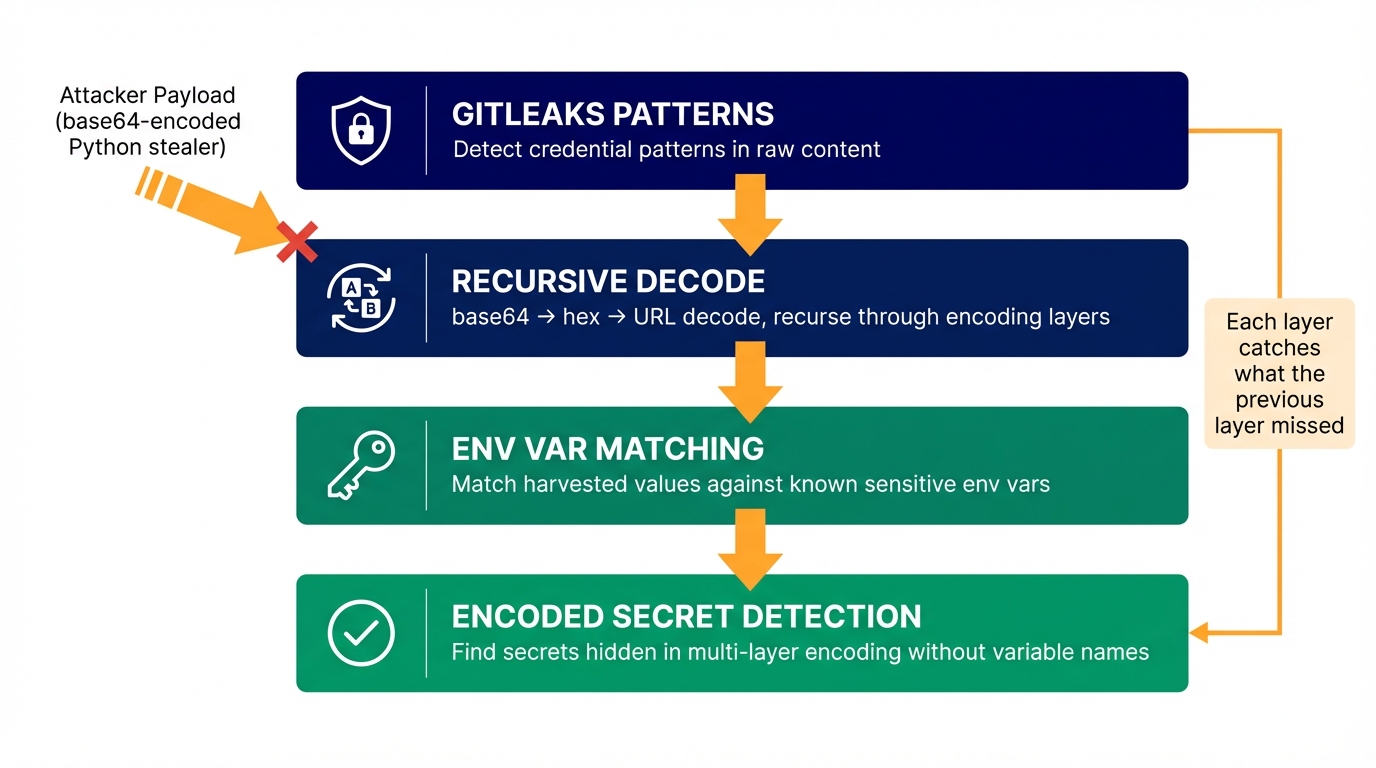
--attestor-secretscan-fail-on-detection blocks the build when any finding fires.
Layer 3: Behavioral detection (catch what the attacker does)
The --trace flag (Linux only) enables ptrace-based syscall capture. Every file each process opens is recorded as openedfiles in the commandrun attestation, along with suspicious syscalls (ptrace, memfd_create, mount, clone). OPA Rego policies match the credential-harvesting filesystem fingerprint:
# policy-trace-behavioral.rego (adapted from 43-trivy-attack-detection)
package cilock.verify

import rego.v1

deny contains msg if {
    some proc in input.processes
    some file in object.keys(proc.openedfiles)
    startswith(file, "/tmp/runner_collected")
    msg := sprintf("Suspicious file access: process %s (PID %d) opened %s, matches credential harvesting pattern",
        [proc.program, proc.processid, file])
}

deny contains msg if {
    some proc in input.processes
    some file in object.keys(proc.openedfiles)
    file == "/proc/self/environ"
    msg := sprintf("Suspicious file access: process %s (PID %d) read /proc/self/environ, environment variable harvesting indicator",
        [proc.program, proc.processid])
}
These are the exact Rego rules used in the attestor-compliance-examples/43-trivy-attack-detection repo to catch the covert variant of the TeamPCP credential stealer. Trace overhead measured on an npm install workload: roughly 36% (5.1s → 6.9s).
For a full walkthrough of how these layers stop the Trivy and LiteLLM attacks, see Defending against supply-chain attacks.
Without CI/lock vs. with CI/lock
What the supply-chain attacks of 2026 looked like, with and without a pipeline observer in place:
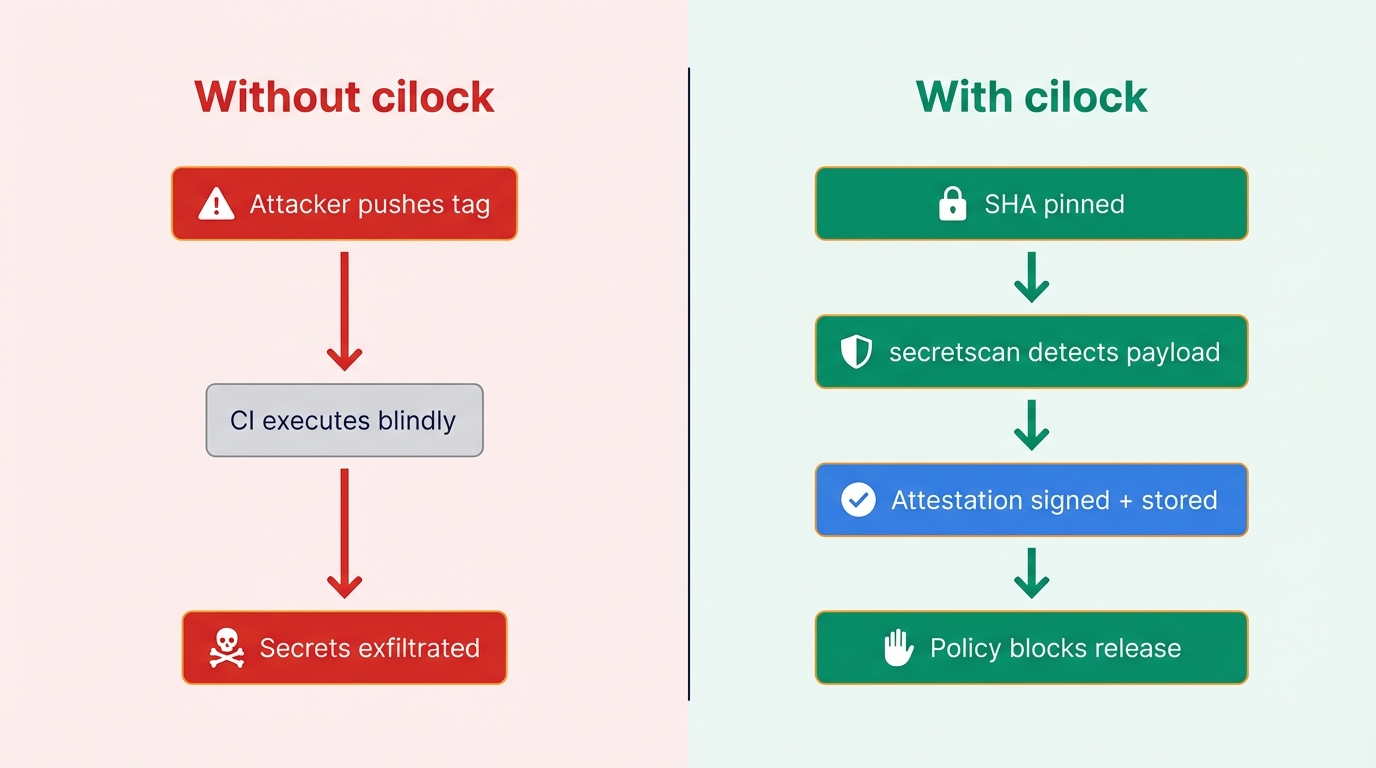
| Without CI/lock | With CI/lock |
|---|---|
| A compromised action or package enters the pipeline | Source policy blocks unapproved actions and packages before they run |
| CI executes blindly with no source or hash verification | SHA and hash pinning are enforced; tag rewrites and package swaps have no effect |
| Credentials are harvested at runtime (SSH keys, cloud creds, tokens, shell history) | Secretscan catches credential patterns in output, including payloads hidden under layered base64, hex, or URL encoding |
| Covert variants write to files instead of stdout, evading log inspection | Trace + OPA catches the credential-sweep filesystem access pattern |
| Encrypted bundle exfiltrated to an attacker-controlled domain | Signed attestation creates a tamper-evident record of what ran and what was accessed |
| No forensic trail of what executed, what was touched, or what was stolen | Policy enforcement blocks the release before any compromised artifact ships |
Mental model: a notary for pipeline steps
If a normal pipeline says "trust me, I built version 1.2.3," CI/lock says "here is signed evidence of the exact commit, command, environment, inputs, outputs, and supporting scan artifacts behind that claim." CI/lock collects trusted telemetry from each step (what ran, where, on what inputs, producing what) and signs the result as in-toto evidence: structured, cryptographically verifiable, portable. The build provenance travels with the artifact instead of staying trapped in one CI tool, and the same envelope shape covers runtime + cluster telemetry (Falco events, Linkerd mesh state, kube-bench, Prowler) at decision time.
Honest limitations
CI/lock is forensic and policy-driven, not a runtime IPS. It produces signed evidence and verifies it against policy at decision points — release time, audit time, deploy time — rather than enforcing inline in real time. We're explicit about the limits because trust costs more to recover than it costs to set:
- Detection is post-execution. If a step exfiltrates secrets during execution, the exfiltration has already happened. CI/lock blocks the release and provides forensic evidence; it cannot prevent the initial exfiltration.
- Network egress is observed, not blocked. The
traceattestor captures everyconnect,sendto, andbindsyscall — destination IP, port, address family, DNS lookups, and TLS SNI hostname extracted from the ClientHello — and policy can fail the build on a bad destination. It does not actively block in-flight traffic the way an inline egress proxy (StepSecurity Harden-Runner, eBPF-based runtime agents) would. --traceis Linux-only and opt-in. Without it, behavioral detection at the syscall layer is off. Covert file-based attacks may evade content scanning alone.- Novel exfiltration techniques can evade pattern matching at the content layer. Behavioral detection (filesystem + network patterns from ptrace) covers many of these; both layers together catch most known playbooks.
- CI/lock is not a continuous runtime agent. It produces signed point-in-time captures of production state via wrapped scans — Falco event windows, Linkerd mesh + mTLS snapshots, Prowler CSPM, kube-bench, testssl.sh — not real-time enforcement on developer laptops or production servers. Continuous runtime enforcement is the role of tools like Falco itself, eBPF agents, or service-mesh sidecars; CI/lock wraps their output into signed, policy-checkable evidence.
How it works
- CI/lock wraps a step. You run a build, test, scan, or packaging command through CI/lock, often in CI but sometimes locally. Each invocation is named via
--stepand represents one step in the supply-chain lifecycle. - Attestors collect facts. Plugins gather facts in five lifecycle phases (pre-material → material → execute → product → post-product): git state, CI metadata, environment details, file digests of inputs and outputs, SBOMs, SARIF, and more.
- Evidence is bundled and signed. The run's attestations are bundled into a Collection and wrapped in a DSSE envelope, then cryptographically signed.
- Evidence is stored or shipped. The signed result can be saved as a file, pushed into Archivista, attached to an OCI image, or attached to downstream release workflows.
- Policies verify the release story. A verifier checks the evidence against a signed policy that lists required attestations, trusted functionaries, and embedded OPA Rego rules.
Media
More context on CI/lock and the supply-chain landscape it addresses:
- 75 Poisoned Tags and Nobody Noticed by Cole Kennedy, March 2026. Trivy tag-rewrite attack walkthrough.
- A .pth File, 34KB of Base64, and Every Secret You Have by Cole Kennedy, March 2026. LiteLLM PyPI attack walkthrough.
- Preventing the Claude Code Leak with Attestation Policies by Cole Kennedy, April 2026. Attestation policies in action.
Where to next
- Want the threat-model walkthrough? Read Defending against supply-chain attacks.
- Ready to try it? Jump to Get Started → Installation or the GitHub Actions tutorial.
- Coming from witness? See ecosystem → Witness for the interop story.